| Books |
| Miniature Books |
| Uniques |
| Other |
| ©1996-2022 Jill Timm |

The Story Behind the Book
The Making of St. Elmo
by Jill Timm
 |
 |
You
could say St. Elmo was a serendipitous accident. It certainly
wasn't on my list of book ideas, nor in my plans for books to
be done in time for the rapidly approaching Miniature Book
Society Conclave.
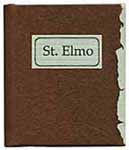
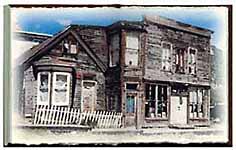
I have photographed thousands of images over the last 30 years. I certainly don't remember all the photos, much less all the places I have been. But I did recall one striking image of frost-encrusted leaves that I wanted to use in a one-of-a-kind book for the annual Miniature Book Society Auction. And I was looking for that image when I came across photographs of a ghost town high in the Colorado mountains. When I saw the images I knew immediately they would make a great book. Once the idea took hold I knew what structure and papers to use. I saw the completed book in my mind (Not all ideas develop so easily!). I wanted to work on this idea a little before it disappeared, as some ideas seem to do. Everything just fell into place for St. Elmo. I did an Internet search to learn more about the town and was surprised how much information I found. This was incorporated into the book introduction, including why the town is named St. Elmo. Most of my edition books have been photographic. But I felt these images would be great as watercolors. I created the watercolor effect in a computer photo manipulation program. When I printed out the first proof, I knew I wanted to keep a copy of this book for myself. So the one-of-a-kind became an edition. Often one of the problems with little books is doing justice to some photos especially horizontal images in a vertical format book. This book solves that problem with the first and last photos, which are of the town from the entering and exiting point of view, each on a 3-page spread that unfolds from the book spine. The top and bottom of the pages are torn edges to give a softer look and feel. St. Elmo is 2.25" x 2.67", it has 28 pages with 7 watercolor illustrations by Jill Timm. St. Elmo has a 2-page introduction, and a colophon. The boards are covered with Beckett embossed and Cave paper with the natural deckled edge. The book is printed using Giclee, a museum quality digital printing method, on Hahnemule Allegretto paper. Limited to an edition of 35, these books are all hand-crafted. Oh, and that book with the frost-encrusted leaves didn't get made...Yet. |
|